Showing posts with label Harry Dean Stanton. Show all posts

1/05/2014


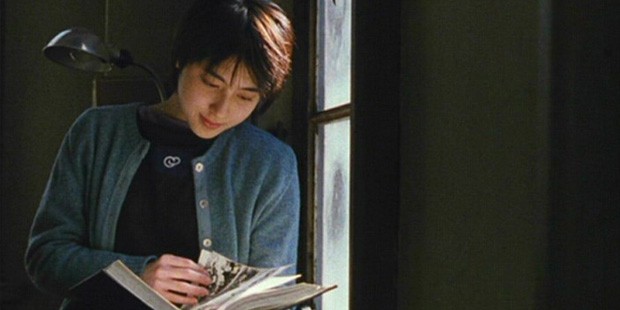
Afterlife
Hirokazu Kore-Eda (1998)
The recently deceased attend a halfway home to the afterlife where they are given a week to choose one memory, which is then re-enacted, filmed and kept for all eternity. There's a bang of film school off the plot but Kore-Eda finds a beautiful realism at its core as scripted scenes are blended with achingly tender true life interviews. They recall their lives, so we recall ours.


Christine
John Carpenter (1983)
A high school outcast discovers, restores, then falls for a battered up- and quite hormonal- Plymouth Fury with a sick mind of its own in this chromed out John Carpenter romp. Coming halfway through the director’s prolific 80s period, Carpenter provides another original score and a profanity fuelled script while barely breaking a sweat. Harry Dean Stanton shows up but strangely not as a sage mechanic. Bonus points none the less.


Meet me in St. Louis
Vincente Minnelli (1944)
The lives of 3 sisters are thrown into very mild disarray when their father decides to uproot the family to take a job in New York. Minnelli’s wafer thin escapist plot isn’t going to teach you much about real life (there was a war still raging in Europe after all) but his film does give us a chance to see America’s Suburban-utopia ideals in their infancy. Judy Garland- who would marry Minnelli the following year- is pitch perfect in the lead role but the standout performance comes from7 Year old Margaret O’Brien. The young actress can’t sing or dance per say, she’s just a kid having a laugh, but amidst all the flawless MGM gloss she makes for a remarkably vital and human presence. As young performances went, it was something of a landmark.


The Searchers
John Ford (1956)

John Wayne stars as a confederate civil war vet who sets out to track a group of Comanche Indians that slaughtered his family and kidnapped his niece. There’s so much about John Wayne’s bumbling character which, unlike many stars of that era, has not aged well but this John Ford classic still has the ability to startle. Considered by many the best western ever made, Ford’s incredible landscape shots of his hallowed Monument Valley have been an influence on countless film makers, not to mention the home world of a certain Luke Skywalker. 


10/01/2013


Resting on the banks of the Spree in the Deutsche Historische Museum lies Berlin's Zeughaus Kino, a beautiful film house and without doubt one of the city's best kept secrets. Comfortable seating, pleasant clientèle and tall handsome windows which overlook the river. The ticket prices are perhaps the city's most reasonable but- for better or worse- It's 165 seats remain sparsely occupied. The cinema boasts some great programming too and last month it played host to Berlin's DokuArts festival, a remarkable documentary festival which focused solely on films about the Arts. Rodney Ascher's juicy Shining conspiracy caper Room 237 was the festival's poster boy (you can read what I said about it here) but DokuArts also offered two of the most profoundly moving studies this writer has seen.


Harry Dean Stanton: Partly Fiction
Sophie Huber (2012)
Sometimes in film making, as in life, it’s better to take a step back. Breath. See the tapestry as a whole. Harry Dean Stanton has been a cinematic enigma his entire career and so for her study of the man, its little surprise film maker Sophie Huber decided to do just that. Shot in the noir-y settings you might hope for- a night drive though LA, Stanton’s local boozer, in black and white at home- her enchanting meditation on the legendary character actor never feels the need to wade in deep. Stanton reflects on an astonishing life: His friendship with James Dean and later with Brando; living with Jack Nicholson; jogging with Dylan. On film he sings with his pal Kristofferson. He drinks a coffee with long time collaborator David Lynch and gives him an interview. He muses on life and the cosmos. It’s a film which accepts that some surfaces are not made to be broken. So when a window is left ajar and we chance a peak inside it hits us even harder. And these moments only come when the actor sings. Revealed in tender close-up, that wonderful weathered façade flickers with longing, regret and who knows what else. Film has always been fascinated with the meandering mind. It's ability to capture it is one of the main things which sets it aside from other art forms. In Stanton we've cherished perhaps America’s best meanderer. Huber seems to know this. Her beautiful documentary does too.

A Story of Children and Film
Mark Cousins (2013)
A perfect companion to Cousins’ near- definitive 15 hour love poem to the movies- The Story of Film an Odyssey- A Story of Children and Film explores, in a similar fashion, what makes kids so damn cinematic. Cousins shoots a home video of his niece and nephew with a marble run and then picks apart what we see. Kids do certain things when they have that sort of cold attention on them- first uncertainty, then playfulness. Showing-off. Wrecking the place. Cousins clocks these traits and then taps that archive of a brain to show them in the movies. With references ranging from more well-known stuff like Kes and ET to leftfield choices from Iranian house arrestee Jafar Pahani and Hirokazu Kore-eda in Japan, the director delivers- in his melodic Belfast lilt- another articulate and heart wrenching visual essay. Only the coldest of hearts need not apply.
 
Twitter Facebook Dribbble Tumblr Last FM Flickr Behance